
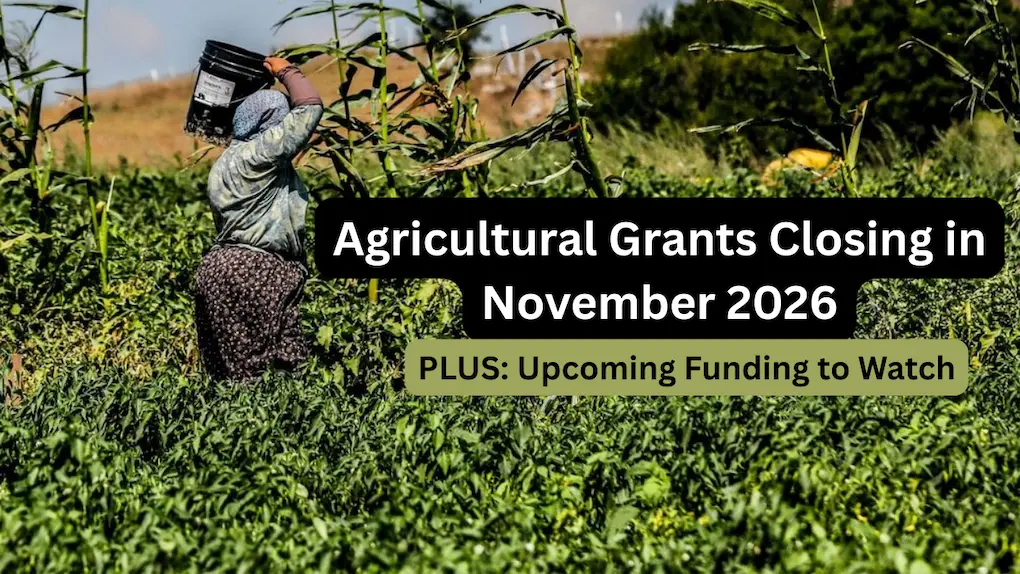
The agricultural sector is a significant contributor to many East African economies, accounting for 20%-35% of the total GDP across the region. Despite this, many farmers and agri-business owners find it challenging to access the capital they need to finance their operations.
A combination of high commercial lending rates, strict collateral requirements, and the perception that agriculture is a high-risk investment due to climate change, pests, seasonal cash flow, and weather patterns is a major driver of this barrier.
Fortunately, many solutions are emerging, including grant funding, which has proven to be a brilliant alternative to commercial bank loans. If you are looking for non-repayable financing opportunities for your agribusiness or agriculture-related project, here are the top agricultural grants closing in November 2026.
FSDT Impact Grant Fund — Tanzania
Application deadline: November 5, 2026.
Funding amount: TZS 30 M
Offered by the Financial Sector Deepening Tanzania (FSDT), the Impact Grant Fund (IGF) is an EU-funded initiative that invests in high-potential Micro, Small, and Medium Enterprises (MSMEs). The initiative is funded under the Inclusive Finance for Growth of MSMEs, Women and Youth (F4G) Program, and serves Mainland Tanzania and Zanzibar.
It focuses on supporting women- and youth-led enterprises. Winners are awarded grant funding of up to TZS 30 million. Additionally, they receive business development support to ensure sustainable operations, create employment opportunities, and increase their chances of securing commercial funding.
Related post: Grants and Resources for Small Businesses in Kenya
FAO Direct Beneficiary Grants — Kenya
Application deadline: November 9, 2026
Funding amount: $5,000 – $100,000
The Food and Agriculture Organisation of the United Nations (FAO) recently announced a Call for Proposals for the Direct Beneficiary Grants (DBGs) under the GEF-7 FOLUR Mt. Elgon Project. The grants are meant to provide financial backing to local organisations working to develop nature-based livelihood enterprises in Western Kenya’s maize and coffee value chains. The funding is geared toward financing a range of small-scale, productive, and tangible investments as well as activities that promote positive environmental effects, including agroforestry and biodiversity conservation.
To qualify, you must be a registered organisation with at least one year in operation. You must be operating within Bungoma and/or Trans-Nzoia counties, specifically in the sub-counties of Kopsiro, Mt. Elgon, Cheptais, Endebess, and Saboti.
The applying organisation must either be a registered Community-Based Organisation (CBO), a Smallholder Forest and Farm Producer Organisation (FFPOs), a Farmer Cooperative, or other member-based local community organisations that are committed to supporting and promoting the coffee, maize, and diversified value chains, or nature-based livelihood enterprises that are relevant to the Ogiek community.
D-Prize Agriculture Challenges — Global
Application deadline: November 15 (Regular deadline), December 6, 2026 (Extension deadline)
Funding amount: Up to $20,000
If you are looking for agricultural grants and resources in Kenya and East Africa, D-Prize is open to social-impact organisations, including those running agricultural initiatives to address poverty. You can select from a wide range of interventions, including providing quality inputs and training to smallholder farmers to improve production. You can also come up with your own evidence-based agricultural intervention that’s not on the list.
KijaniSpace Space-IoT Innovation Programme — East Africa
Application deadline: November 16, 2026
Funding amount: €5,000 per team
This program supports eligible SMEs and start-ups to improve existing agricultural products, services, or applications. The programme selects up to five teams from Kenya, Tanzania, and Uganda who will use Copernicus Earth Observation and IoT resources from the Space-IoT Box to upgrade existing climate-smart agriculture and aquaculture solutions. Each of the selected teams receives €5,000 in funding, along with mentoring and validation support. To qualify, you must have an existing agriculture-related product, service, or application and be operating from Kenya, Uganda, or Tanzania.
Related post: How to Get Your CBO Ready for Funding
Kenya–Uganda Adaptation Accelerator — Upcoming Funding to Watch
Application deadline: The official call is scheduled to launch in November, with applications accepted on a rolling basis. The deadline has not yet been announced.
Funding amount: Up to $50,000
The Kenya-Uganda Adaptation Accelerator (KUAA) is an initiative funded by the Adaptation Fund and implemented by UNIDO in partnership with Kenya Climate Ventures, adelphi, and Finding XY. The $5 million four-year programme was established to support SMEs delivering climate adaptation products or services, with a focus on gender- and youth-inclusive ventures in Kenya and Uganda.
At least 100 adaptation SMEs will receive business acceleration support, and a subset of 30 ventures, at least 15 of which must be women-led, will be awarded up to $50,000.
Before You Apply for These Agricultural Grants…
If you want to maximise your chance of winning any of these agricultural grants closing in November 2026:
- Audit your eligibility. Ensure you are legally registered within the eligible countries. Have registration certificates and tax compliance documents ready, where applicable. Ensure you operate within a programme’s priority areas, such as climate-smart agriculture for KUAA.
- Prepare technical and financial proof. Gather the necessary data, depending on the nature of your agricultural operations. You should be able to answer how your proposed solutions improve lives. Set a specific budget and clearly explain how you will allocate the funds for your cause.
- Have your pitch and team profile polished, ensuring you showcase your technical skills and ability to execute. Also, ensure you highlight a programme’s priority. KUAA, for instance, focuses on women- and youth-inclusive ventures, so you should demonstrate how your leadership structure or primary beneficiaries align with this.