

If you’ve been looking for grants, you’ve probably heard about matching grants and don’t understand what they mean. They are a strategic funding mechanism that can significantly enhance your impact. And it’s important for organisations to understand how these programmes operate and how to work with them effectively.
What separates it from the traditional grant programs, which award a fixed amount of money, is that it pushes nonprofits and social-impact businesses to actively take part in raising funds from other sources.
When managed well, this strategy cannot only boost organisations’ funding base but also increase donor engagement, build trust with stakeholders, and enhance community engagement and support. In this guide, we will explain what matching grants are, the types of matching grants, and how NGOs can benefit from them.
What is a Matching Grant?
Matching grants are a form of conditional funding in which funders award money only when an organisation contributes a set amount from other sources, usually at a predetermined ratio. The essence of this funding strategy is to inspire collaboration between donors and NGOs towards a common goal.
The concept originated in the early 20th-century philanthropic giving, where foundations refrained from simply handing out large sums of money and instead introduced ‘challenge’ gifts, awarding a lump sum only if local institutions independently raised an agreed amount. The goal was to incentivise local engagement, eliminate total financial dependency, and laverage external resources. Over time, the ‘all-or-nothing” funding scheme has gained popularity, evolving into proportional matching formulas, such as:
- The 1:1 ratio or ‘the dollar-for-dollar match’: this is where donors award $1 for every $1 the organisation independently raises. If, for instance, a project costs $20,000, the grant program offers $10,000, and your non-profit will be required to contribute $10,000.
- X:1 incentive ratios: Here, the donors agree to provide $3, $2, or more for every $1 the organisation contributes.
- Percentage of total project cost: This is where organisations are required to contribute a fixed portion of the whole budget. For example, if the project’s total budget is $50,000, a 20% match means the applicant raises $10,000, which increases the project funds to $60,000.
Why Institutional Donors Require Matches

It’s natural to ask yourself why a funder would require your own financial contribution before being awarded the grant you applied for. Matching funds are more than just a smart fundraising strategy; they are a great way to increase donor engagement and build healthy, long-lasting relationships with funders. Here are the main reasons for matching requirements and how your organisation can benefit:
- It amplifies the impact. People are more likely to donate when they know the award will be doubled or tripled.
- It acts as social proof. A donor pledging a matching gift signals that the organisation or charity is vetted and trusted, increasing the likelihood that more people will join in supporting the project.
- It creates a sense of urgency. Time-limited matches create deadlines, which prompt organisations to act fast and avoid delay, maximising impact.
- It significantly increases total revenue. Matching funds unlocks a much larger pool of capital.
- It creates a sense of mutual investment by requiring organisations or local communities to contribute towards the project cost. When grant recipients risk their own resources (time & money), they are more likely to care more about the project’s success. Moreover, the shared financial commitment creates a more collaborative effort rather than the traditional top-down handout.
- It boosts funder confidence. Meeting matching requirements showcases an organisation’s ability to mobilise resources from its local community or external sources, which in turn boosts the funder’s confidence in the project being supported.
The 4 Main Types of Matches in East Africa
Matching grants are a widely used funding mechanism in East Africa across agriculture, SME development, renewable energy, and more. Matches come in different types depending on how receivers are required to contribute to the project budget.
The 4 Main Types of Matching Grants
Cash Match.
This is actual physical money that an organisation raises from its own reserves or revenues.
In-Kind Match.
This refers to any non-cash contribution. It can include donated equipment, land usage, staff time, or professional services.
Third-Party Parallel Funding.
These are grants raised with the help of other donors applied to the same project.
Community Contributions.
These refer to support generated directly from the local community. It can include local labour, volunteer time, and donated space, such as land or free venues.
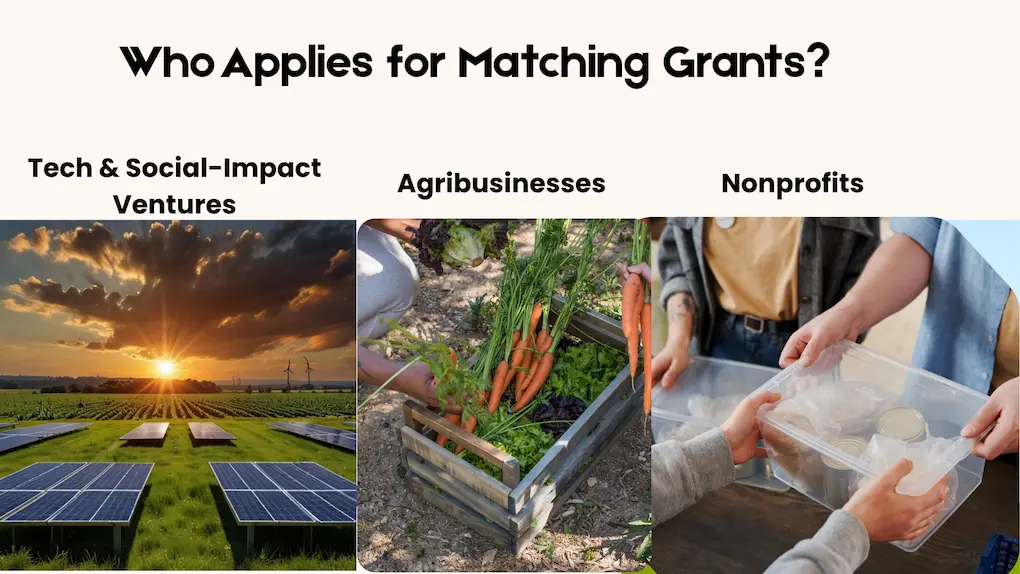
Who Applies for Matching Grants in East Africa?
- Agribusinesses and SMEs: Matching grants are a reliable funding strategy for cooperatives and enterprises operating in high-growth value chains, such as dairy and horticulture. The COMESA-EAC Horticulture Accelerator (CEHA) is a brilliant example of a programme that provides matching grants to eligible small and medium-sized enterprises, thereby facilitating value chain development.
- Tech and social-impact ventures: Enterprises working to solve pressing public problems, such as waste management, clean energy, and asset financing, apply for matching funds through accelerators and venture builders, including Impacc, E4Impact, and Antler East Africa.
- Nonprofits and Community Organisations: Local organisations and grassroots can source matching funds through programmes, such as the Australian High Commission’s Direct Aid, one of the top grants for NGOs in Kenya and East Africa, along with localised initiatives via organisations, like the Kenya Community Development Initiative.
Related post: Why Your CBO Isn’t Winning Grants (& How to Fix It)
How to Calculate Match Ratios Without Hurting Your Cash Flow
Participating in matching grant programs is exciting and transformative for many NGOs. However, it should be handled with care, especially when it comes to calculating the match ratios. Maintaining accuracy while managing the organisation’s liquidity is vital because not doing so can lead to an operational crisis
To calculate the ratios without depleting your operational cash reserves:
- Calculate your total match amount. To determine the exact amount you’re required to raise, you need to understand the match ratio formula. As we’ve already discussed, donors provide matching funds as either a ratio or as a percentage of the project budget. Failure to understand how these formulas work is one of the reasons many nonprofits end up messing up their cash flow.
- Stack your non-cash assets first. Before touching your physical money, use in-kind contributions to cover the match requirement as much as possible. Determine the real market value of the community volunteers, office space, and staff time, and deduct it from what you’re required to contribute.
- Avoid paying out matching funds all at once. Paying overtime ensures cash flow protection.
- Use a separate reserve for your match funds. Put the match money in a different bucket, separate from the rest of your operating cash.
- Check your free cash flow. Ensure you have enough free cash to cover upfront project costs and run your usual operations, including handling payroll as you wait for donor disbursements, which normally happen after the project work is done.

Why This Calculation Is Vital to Your Organisation’s Survival:
Avoid Running Out of Money
Grants pay you back after you spend. If you lock up all your cash as a match, you cannot pay your daily bills.
Cover Unexpected Costs
Match money is locked in contractually. You need free cash left over to pay salaries and rent when surprise expenses pop up.
Multiply Your Dollars
Exact calculations help you pick better grants. A 1:4 match quadruples your money, bringing in more funding for less cash.
Protect Your Reputation
Running out of money mid-project forfeits the grant. Donors share compliance records, and a failed match hurts future funding.
Tip: Check out our free compliance tools and tracking templates on the GrantsHaven Resources Page to protect your cash flow.
Frequently Asked Questions
How does a donor match work?
A donor match works as a financial incentive, in which a funder donate towards a project if the receiver raises an agreed amount of money. The matching donor can contribute an equal or a proportional amount until the set limit is reached.
How to get matching donations?
To get matching donations, NGOs can use of global donors, such as USAID and EU. They can also work in partnership with regional institutions, such as Equity Bank or Safaricom for CSR matches and utilize mobile crowdfunding.
How do I know if my NGO is eligible for matching grants?
To know if your organisation is eligible for matching funds, check the funder’s guidelines for co-contribution requirements. Most global donors, such as USAID, require organisations to be registered and operate legally, have a track record of managing budgets, and be able to contribute a portion of the project budget (usually 10-20%).
Conclusion
To conclude, matching grants are a transformative funding strategy that can significantly sustain organisations’ finances and ensure a much bigger impact. However, they also come with responsibility, requiring discipline, accuracy, a well-structured organisational system, and accountability to work effectively. When approached and managed correctly, matching grants can help NGOs and social enterprises create long-lasting changes in East African communities.