

Logical Framework (LogFrame) is one of the most essential tools in the nonprofit world, helping organisations navigate complex projects. In this article, we’ll walk you through what the term means, the components, structure, and why donors demand it.
What Exactly is a LogFrame?
A logical framework, or as many people know it, LogFrame, is a management tool that organisations use in planning, monitoring, and evaluating projects. It offers a clear, structured strategy for planning a project’s progress, illustrating how activities lead to results and the project’s long-term impact. It also displays the measures that the organisation will use to assess the project’s progress.
The United States Agency for International Development (USAID) in developed the Logical Framework Approach in 1969, out of a need to evaluate the real-world impact it was generating through its global development programs. USAID successfully implemented the model in many countries in the 1970s. In the 1980s and 90s, the likes of the European Union, the World Bank, and the UN Agencies adopted it as well.
Today, it has become a universal standard that many international funders and NGOs use to ensure transparency, accountability, and logic in projects.
Related post: Why Your CBO Isn’t Winning Grants (& How to Fix It)
Components of a Logical Framework
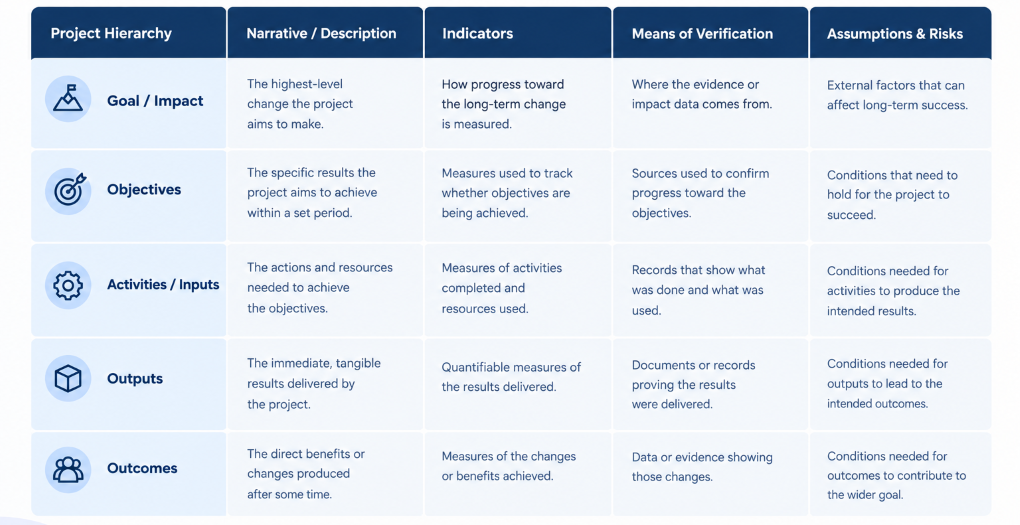
A LogFrame has five key components:
- Goal/Impact: The highest-level developmental change the project aims to make, often aligned with the organisation’s mission and vision.
- Objectives. The specific results the project intends to produce within the stipulated period.
- Inputs/Activities. The actions the project will take will achieve the objectives.
- Outputs. The immediate tangible and measurable results delivered after the end of the project.
- Outcomes. The direct benefits, changes, or results produced after a period of time, not immediately after the project’s completion.
Supporting Elements
These are factors that influence how well the project works. While the vertical logic (the key components) outlines a project’s master plan, these supporting elements ground the strategy in real-world reality, turning the concept into an operational framework that organisations can monitor and measure for success. They include:
- Indicators. The criteria a project uses to assess progress and measure results.
- Means of Verification. The sources of information or data collection methods the project uses to measure the indicators
- Risks & Assumptions. External factors that influence how a project performs. Assumptions are conditions necessary for a project’s success, and often follow an if…and…then…sequence. For instance, if we train women entrepreneurs and provide them with seed capital, and the demand for their products remains high without undergoing heavy inflation, then the participants will enjoy increased average household incomes. Risks, on the other hand, represent the possible factors, events, or conditions that could interfere with the project’s progress. This follows the if…but…then rule. For instance, if we train women entrepreneurs and provide them with seed capital, but a sudden spike in inflation occurs, significantly reducing the demand for products, then the participants’ average household income will not increase.
The Structure of a Logical Framework
Any LogFrame is formatted as a 4×4 matrix, with the project’s core plan/strategy outlined on the vertical rows, and the supporting elements (measurement tools and external factors) represented in the horizontal columns.
Why Do Donors Demand a Logical Framework?
While applicants tell inspiring stories through their grant proposals, LogFrames allow donors to evaluate where their money goes, breaking down complex projects into a simple, manageable format that showcases how the organisation’s daily activities will lead to the project’s long-term goals. Here’s a breakdown of why LogFrames are a key requirement for international grant seekers:
- They show the core logic of a project. Emotional stories are great, but funders want to see the exact plan. By forcing nonprofits to remove the extra words, LogFrames serve this purpose, cutting through the fluff to showcase the specific blueprint.
- They save time. Grant reviewers review dozens of applications, which takes a lot of time if you have to read a multi-page narrative to understand a project. The single-page LogFrame matrix means donor program officers don’t have to hunt for details; they can see the plan, the logic behind it, and the anticipated results at a glance.
- They test for real-world risks through the fourth column, Assumptions and Risks, where organisations are forced to determine external factors that are beyond their control that can affect the project’s failure or success.
- They guarantee clear proof. Through Means of Verification (MoV), which states exactly where and how the organisation will gather evidence, LogFrames force organisations to set up tracking systems, such as financial audits and photo logs, so that they can build in the evidence right from the start.
- They protect the donor’s accountability. When donors fund projects, they aren’t spending their own money. They are managing taxpayers’ money, corporate revenue, or foundation endowments, and therefore have people to answer to. A project failing to achieve its goals can put donors under intense scrutiny over wasted resources. A LogFrame offers an explicit audit trail, which funders can use to explain themselves should there be a need to.
Related post: Grant Readiness Checklist: Get Your Nonprofit Funding-Ready
Is the Logical Framework Always a Requirement for East African Nonprofits?
Whether LogFrames are a requirement for East African nonprofits depends on who you are getting financial backing from and the scale of the funding. If your NGO or CBO is seeking large-scale international grant funding, then it’s a mandatory requirement. Major donors, such as the European Union and UN agencies, demand LogFrames to move applicants through the initial screening process.
Donors will be less likely to demand the LogFrame for small, local grants or emergency-response financial support.
Note: Some progressive international trusts and foundations also don’t make this a requirement; instead, they prefer the Theory of Change (ToC), which is more narrative, explaining the organisation’s pathway of change, from the underlying problem to the long-term solution. A LogFrame focuses on what the organisation will do and what will happen as a result, while a ToC explains why and how the actions will produce the stipulated results.
Although they have been criticised for their rigid nature, logical frameworks are a robust foundation of project management, ensuring organisations lead with clarity, stakeholder alignment, and a measurable strategy for success.